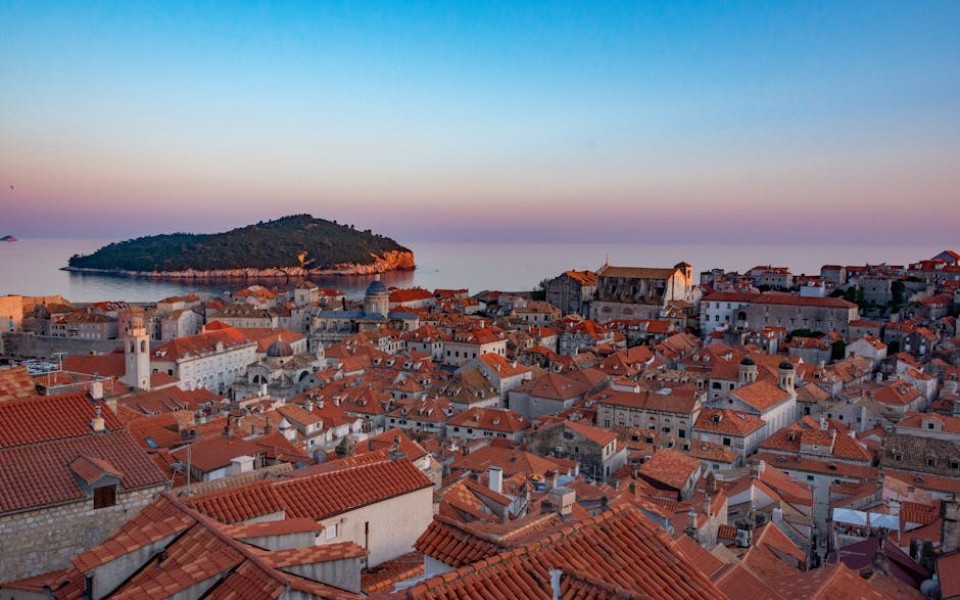
1) Old Town skyline from the open sea (your “establishing shot”)
A great Dubrovnik photo often starts before you reach any gate: with the Old Town rising directly from the water, framed by the city walls and terracotta rooftops. From a boat, the shoreline perspective makes the town look cinematic—especially when the sea is calm and the light is low. This is the kind of wide shot that instantly communicates “Dubrovnik” without needing captions.
For a cleaner photo, move far enough out to include the full sweep of the city wall line while keeping the horizon straight. If you’re on a private tour with Adriatic Boat Tours, ask your skipper to slow down briefly so you can shoot with less motion blur and get a crisp “postcard” view.
2) Dubrovnik city walls from sea level (texture, scale, drama)
Most visitors experience the Dubrovnik city walls from above; photographing them from sea level flips the story. From the water, every stone course, shadow, and curve reads as monumental. This angle is especially strong for tighter compositions—details of towers, embrasures, and weathered limestone—where the wall becomes the subject rather than the background.
For a good photo, look for moments when the sun rakes across the surface and reveals texture. A slightly longer lens (or a simple phone zoom used carefully) helps isolate sections of the city walls without crowd distractions.
3) Fort Lovrijenac from the water (a fortress that photographs like a legend)
Sitting outside the western edge of the Old Town, Fort Lovrijenac has one of the most recognizable silhouettes on this stretch of coast. From the sea, the fortress looks carved into the rock—an ideal photo spot for dramatic contrast between stone, cliff, and deep blue water.
This stop is also a subtle nod for fans of Game of Thrones, as the setting is strongly associated with the series’ Dubrovnik locations. Even if you’re not recreating scenes, the composition is naturally powerful: fortress high, sea low, and the city behind if you choose a wider view.
4) Pile Gate area from offshore (the city’s rhythm in one frame)
From the land, the gate area can feel busy. From the sea, it becomes graphic and balanced: defensive walls, the approach to the town, and the curve of the coastline all combine into a single readable image. The best angle is usually a modest distance offshore where you can keep the Old Town walls intact in the frame while still showing the approach to the town.
If you want a “people-and-place” image, capture small boats crossing the foreground. It gives scale and tells the story of Dubrovnik as a city shaped by the sea.
5) Banje Beach and the Old Town backdrop (the classic Dubrovnik contrast)
For many travelers, Banje Beach is the iconic “swim with a skyline” moment. From a boat, the angle is flattering: turquoise shallows, beach curve, and the walled city behind. It’s an excellent spot in Dubrovnik for a layered composition—beach, water, architecture, and sky.
A good time for photos is when the sun is not directly overhead, so the sea keeps its color and the limestone walls don’t blow out. If you’re aiming for a “travel magazine” look, place the beach in the lower third and let the Dubrovnik city walls rise behind it.
6) Lokrum Island coastline (wild greens, dark rocks, clear water)
Just off Dubrovnik, Lokrum offers a different mood: dense vegetation, rugged shoreline, and clear sea that shifts color with depth. From a photography standpoint, it’s a refreshing contrast to the geometry of the Old Town. Use this stop to capture nature-focused frames—rippling water over rock shelves, small coves, and the deep greens that make the blue look even brighter.
For sharper images from a moving boat, keep your shutter fast (or use your phone’s burst mode) and stabilize your stance. The goal is a clean photo that feels calm even if you’re in motion.
7) Hidden coves near Dubrovnik (the “private postcard” shot)
The most memorable images are often taken away from the obvious viewpoints: a quiet inlet, a reflective surface, a narrow opening between rocks, or a sheltered bay where the water turns glassy. These hidden places are what private boat days do best—letting you reach small coves that feel like your own.
A strong approach is to shoot two versions: one wide image that shows the full cove and one tighter frame that focuses on color and texture—sunlight patterns on the water, rock edges, or a swimmer as a scale reference. This is where your best “I can’t believe this is real” shot tends to happen.
How to get better photos on a boat (without overthinking it)
The difference between a snapshot and a good photo at sea is usually small technique, not expensive gear:
- Use the boat’s rail or a seated position for stability when possible.
- Keep horizons level; the sea exaggerates tilt.
- Wipe your lens often—salt mist softens images quickly.
- Shoot in short bursts; you’ll catch cleaner frames between small waves.
- If you want a crisp architectural view, ask for a brief slow-down so the boat’s motion doesn’t blur the walls.
Safety and legal note for jet ski rentals (what guests are told before every rental)
Before every jet ski rental, guests receive clear instructions on how to operate the jet ski and which laws and rules must be followed. This includes practical guidance for safe handling, awareness of other vessels, and respectful behavior near swimmers, beaches, and coastal zones—so you can enjoy the sea, protect others, and still come home with the photos you wanted.


